

Do you look at the clock and wonder if 7 PM is morning or evening? Lots of people feel confused by AM and PM. You see these two words every day, but knowing what they mean is key. You need to understand AM and PM to schedule a meeting, catch a bus, or plan your day clearly.
This guide gives you a simple, direct answer. You will learn what AM and PM mean, where they come from, and how to use them right every single time. Stop guessing about time. Start being sure about your schedule.
What Do AM and PM Really Mean?

People often get confused because they don’t know what the letters stand for. When you learn the meaning, the whole system becomes clear.
The Meaning of AM
AM stands for Ante Meridiem. This is a Latin phrase.
- Ante means before.
- Meridiem means midday or noon.
So, AM means before noon.
The AM time starts right after midnight (12:00 AM). It lasts until the moment before noon (12:00 PM). This is the time you wake up, go to work or school, and the first part of your day. It includes all the morning hours.
The Meaning of PM
PM stands for Post Meridiem. This is also a Latin phrase.
- Post means after.
- Meridiem means midday or noon.
So, PM means after noon.
The PM time starts right after noon (12:00 PM). It lasts until the moment before midnight (12:00 AM). This includes your lunch time, the whole afternoon, evening, and the night hours until a new day begins.
The Tricky Numbers: 12 PM and 12 AM
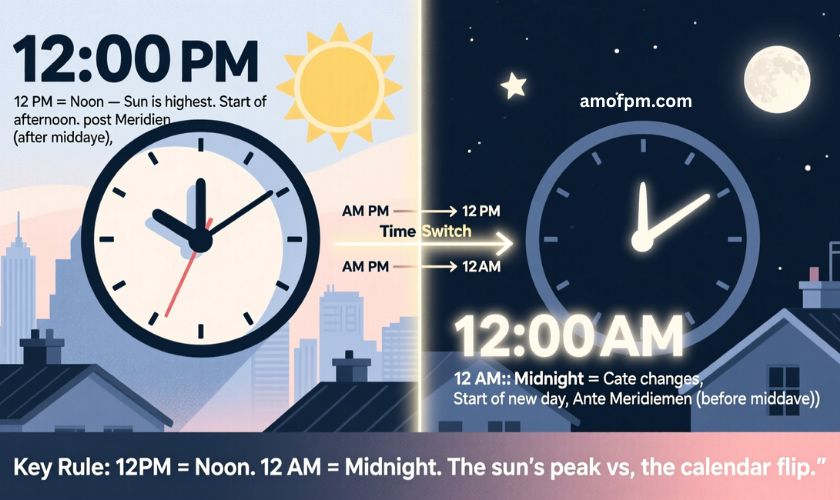
The most common mistake involves the number 12. Because both noon and midnight use 12, people get them mixed up. Here is the easy rule to follow.
12 PM is Noon
- 12 PM means 12 Post Meridiem.
- This is the exact moment of midday.
- The time switches from AM to PM here.
- Think: 11:59 AM is the morning. One minute later, it’s noon. Noon is the start of the afternoon. After noon is PM. So, 12 PM is noon.
12 AM is Midnight12 AM means 12 Ante Meridiem.
- This is the exact moment of midnight.
- The time switches from PM to AM here.
- Think: 11:59 PM is the end of the night. One minute later, a new day starts. The new day begins with morning hours. Before noon is AM. So, 12 AM is midnight.
Key Idea: 12 PM is when the sun is highest (lunch time). 12 AM is when the date on the calendar changes.
Read: AM of PM Betekenis: Decoding the True Meaning of AM and PM Time
Why We Use the 12 Hour Clock
The reason we need AM and PM is simple. The 12 hour clock only uses the numbers 1 through 12. Without AM and PM, if you say 4:00, a person doesn’t know if you mean 4 in the morning (when you are likely sleeping) or 4 in the afternoon (when you might be leaving work).
AM and PM bring necessary clarity. They tell you which half of the full 24 hour day you are talking about. You know right away if a 9:00 meeting is at the start of your workday or late in the evening. This clear system helps everyone schedule and communicate correctly.
A Look Back: The History of the 12 Hour Clock
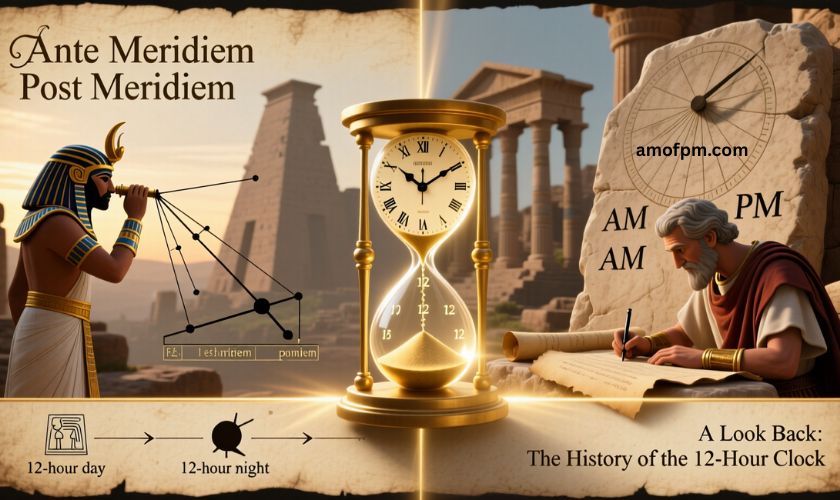
The idea of dividing the day into 12 parts is very old. It started with the Ancient Egyptians.
The Egyptians used a base 12 system for counting. They likely used the 12 knuckles on their four fingers, not counting the thumb. They split the day into 10 hours of daylight. They added one hour for dawn and one hour for dusk. This made 12 hours for the day. They also divided the night into 12 hours. This created the first 24 hour cycle broken into two halves.
Later, the Romans formalized the ideas of before noon (ante meridiem) and after noon (post meridiem). This marked the time before and after the sun reached its highest point. This ancient practice is the system you still use today. It stayed popular in many countries, like the United States and Canada.
Moving Between 12 Hour and 24 Hour Time
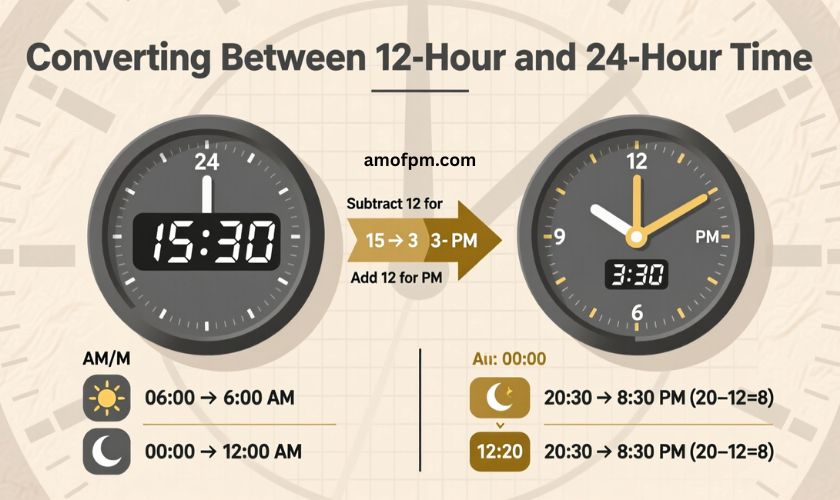
Some things use the 24 hour clock (often called military time). This clock removes AM and PM by using a unique number for every hour, from 00:00 to 23:59. You see this on airplane tickets, in hospitals, and in computer settings.
It helps to know how to move between the two systems.
1. Change 24 Hour Time to 12 Hour Time
- Morning hours (00:00 to 11:59): These are AM hours. Just keep the hour number.
- 06:00 is 6:00 AM
- 10:15 is 10:15 AM
- 00:00 (Midnight) is 12:00 AM
- Noon (12:00): This is 12:00 PM.
- Afternoon and Evening (13:00 to 23:59): These are PM hours. You just need to subtract 12 from the hour number.
- 15:00 is 3 PM (15 minus 12 equals 3)
- 20:30 is 8:30 PM (20 minus 12 equals 8)
- 23:59 is 11:59 PM (23 minus 12 equals 11)
2. Change 12 Hour Time to 24 Hour Time
- AM hours (12:00 AM to 11:59 AM):
- For 12:00 AM (midnight), the 24 hour time is 00:00.
- For all other AM hours, use the hour number. Put a zero in front if the number is less than 10.
- 2:00 AM is 02:00
- 11:45 AM is 11:45
- PM hours (12:00 PM to 11:59 PM):
- For 12:00 PM (noon), the 24 hour time is 12:00.
- For all other PM hours, you need to add 12 to the hour number.
- 1:00 PM is 13:00 (1 plus 12 equals 13)
- 9:10 PM is 21:10 (9 plus 12 equals 21)
Knowing how to switch between these two systems helps you communicate clearly, especially when dealing with people in other countries or when reading certain schedules.
Easy Tips for Using AM and PM Correctly
Using AM and PM right stops common mistakes that waste time and cause trouble. Follow these simple rules to be exact with your time.
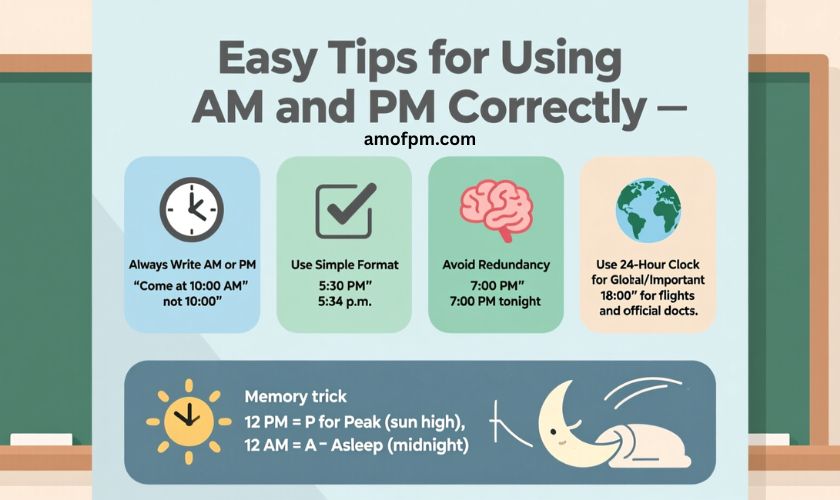
1. Always Write AM or PM
If you use the 12 hour clock, you must always add AM or PM. Never write “Come to my office at 10:00.” This is unclear. Write “Come to my office at 10:00 AM” or “Come to my office at 10:00 PM.” Make your meaning crystal clear.
2. Choose a Simple Style
Use a style that is easy to read. The best way is h:mm AM or h:mm PM.
- Use a period (or no dots at all) after A and M, or P and M. Do not use complex symbols like colons or hyphens.
- Write this: 5:30 PM, 5 PM
- Don’t write this: 5:30 p.m., 5:30 P.M.
3. Don’t Say the Same Thing Twice
Avoid using extra words that repeat what AM or PM already says.
- Do not write: “The class is at 7:00 PM tonight.”
- Write instead: “The class is at 7:00 PM.”
- Do not write: “I will call you at 10:00 AM this morning.”
- Write instead: “I will call you at 10:00 AM.”
AM already means morning. PM already means afternoon or night. Be direct.
4. Use the 24 Hour Clock for Big Events
If you are talking to people worldwide, or if you schedule something very important where a small mistake is serious, use the 24 hour clock. The 24 hour system is a single, clear scale. 18:00 can only mean one time. You should use the 24 hour format for flight times, official forms, and speaking with people globally.
5. Create an Easy Memory Trick
To stop mixing up 12 AM and 12 PM, make a simple connection in your mind.
- 12 PM: P is for Peak. The sun is at its highest peak in the sky.
- 12 AM: A is for Asleep. You are usually asleep at midnight when the day starts over.
Choose any trick that helps you remember the difference easily.
The Value of Being Clear with Time
Knowing AM and PM is more than just avoiding missed meetings. It helps you manage your day better. When you use exact, clear words, you communicate well and feel more confident. Being precise about time shows you are careful and professional in everything you do.
You stop confusion for yourself and others. Think about the time you save by not having to ask, “Did you mean morning or evening?” Time is valuable. You use these simple words to protect your time and others’.
Conclusion
AM and PM are very simple tools. Their strength is in their clarity. They take the confusion out of the 12 hour clock and split the day into two easy halves.
You now know that AM means before noon and PM means after noon. You know the key difference between 12 AM (midnight) and 12 PM (noon). You are now ready to talk about your schedule without mistakes. Stop letting time confusion rule your life. Use these simple words right, and take charge of every day.
Simple Questions About AM and PM
What does AM mean?
AM means Ante Meridiem, which is Latin for “before noon.” It is the time from midnight until noon.
What does PM mean?
PM means Post Meridiem, which is Latin for “after noon.” It is the time from noon until midnight.
Is 12 PM noon or midnight?
12 PM is noon. It is the middle of the day. It’s when the time switches from AM to PM.
Is 12 AM noon or midnight?
12 AM is midnight. It is the middle of the night. It’s when the date changes and the time switches from PM to AM.
How can I remember 12 AM and 12 PM?
Remember that 12 PM is when you eat lunch (the middle of the day). 12 AM is when you are asleep (the middle of the night).
Should I write 8:00 AM or 8 AM?
Both are fine. You can write 8:00 AM or 8 AM. The most important thing is that you must include AM or PM so people know if you mean morning or evening.
Why do some people use the 24 hour clock?
Many people use the 24 hour clock (like 13:00 instead of 1 PM) because it is never confusing. Every time has its own number from 00:00 to 23:59. This is very helpful for travel and talking to people around the world.
Do I need to put a dot after A and M?
You can use A.M. or P.M. with dots, or just AM or PM without dots. Both ways are okay. Just pick one way and use it all the time.