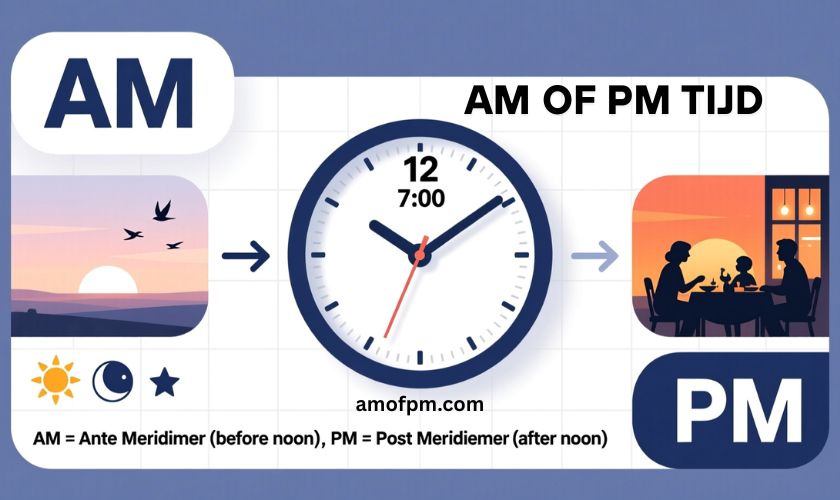

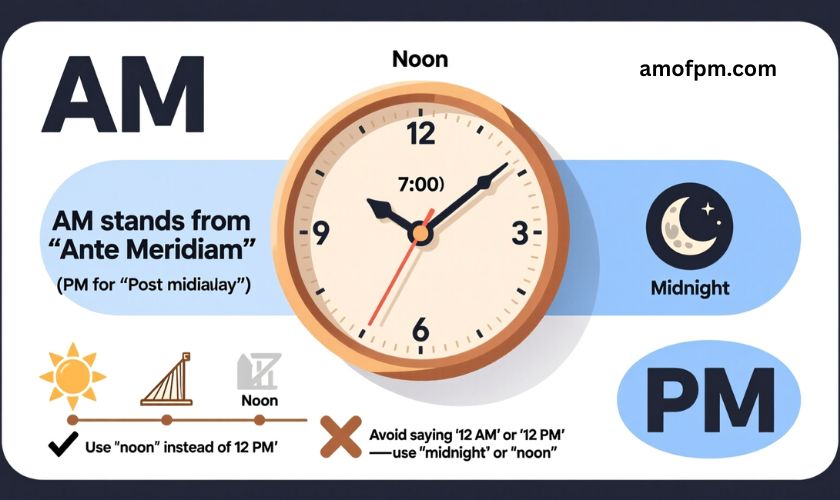
You tell time every day. You know that 7 in the morning is different from 7 at night. We use AM and PM to make sure everyone knows the exact time. These two short names clear up all confusion.
Do you know what AM and PM stand for? Where do they come from? When should you say noon or midnight instead?
This guide makes it simple. You will learn the history and the easy rules for using AM and PM perfectly every time you talk about the clock.
What Do AM and PM Mean?
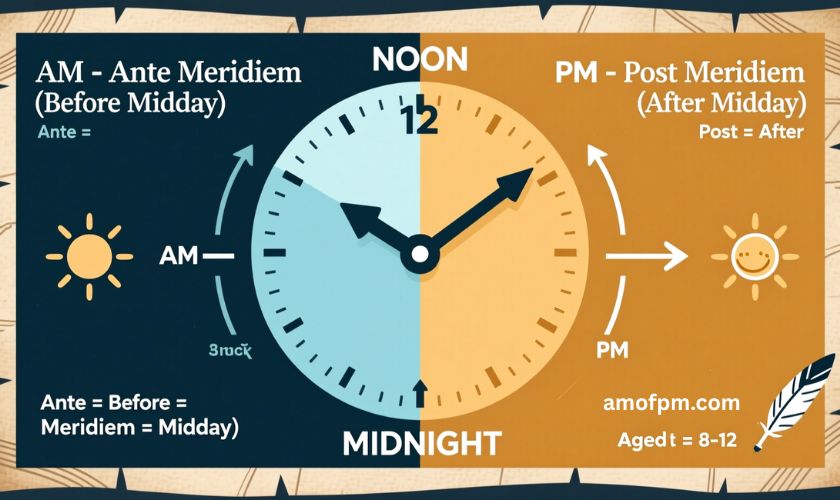
The names AM and PM come from an old language called Latin. Long ago, important thinkers and writers used Latin.
- AM means Ante Meridiem.
- Ante means before.
- Meridiem means midday or noon.
- So, AM means before noon.
- PM means Post Meridiem.
- Post means after.
- So, PM means after noon.
Look at your day:
- AM is the time from when the day starts (midnight) until the middle of the day (noon). These are your morning hours.
- PM is the time from the middle of the day (noon) until the day ends (midnight). These are your afternoon and evening hours.
Noon is the straight line that splits the day in half.
The 12 Hour Clock: Two Cycles
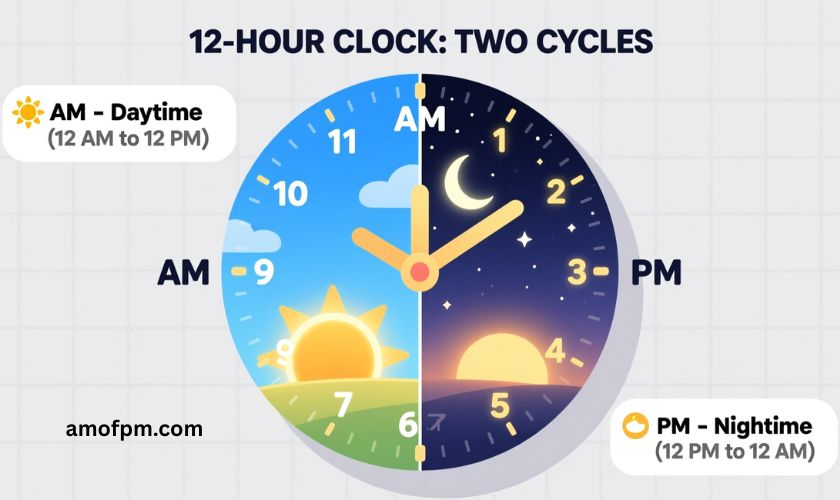
We use the 12 hour clock system. This system takes the 24 hours in a full day and splits them into two halves, or two cycles, of 12 hours each.
- The First Cycle (AM): This goes from 12 AM (midnight) up to 12 PM (noon). This is the time when the sun rises and shines brightly.
- The Second Cycle (PM): This goes from 12 PM (noon) up to 12 AM (midnight). This is the time when the sun goes down and the stars come out.
This 12 hour system is very helpful because it matches how we feel about day and night. When you see 9 AM, you know it’s bright outside. When you see 9 PM, you know it’s dark.
The Tricky Times: Noon and Midnight
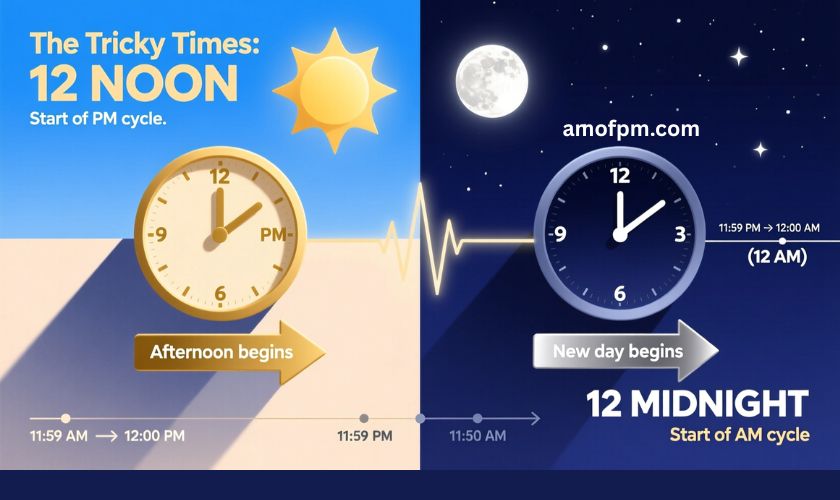
These two times cause the most trouble. It is hard to know if 12 o’clock is AM or PM.
12 Noon (12 PM)
Noon is the exact time when the sun is highest in the sky. It is the middle of the day.
We call 12 noon the start of the PM cycle.
- Think about it this way: The moment the clock moves from 11:59 AM, it becomes 12:00 PM. This is the start of the “after noon” time.
- Best Rule: Instead of saying “12 PM,” simply say “noon” or “12 noon.” This is the clearest way to talk about the middle of the day.
12 Midnight (12 AM)
Midnight is the moment when one day ends and a brand new day begins. It is the start of the entire 24 hour day cycle.
We call 12 midnight the start of the AM cycle.
- The moment the clock moves from 11:59 PM (at the end of Friday), it becomes 12:00 AM (the start of Saturday). This begins the “before noon” time.
- Best Rule: Avoid using “12 AM.” Say “midnight” or “12 midnight” instead. If you are talking about a date, say the day you mean, like “midnight on Friday night” to be absolutely sure.
The Story of Time: Where the 12 Hour Clock Started
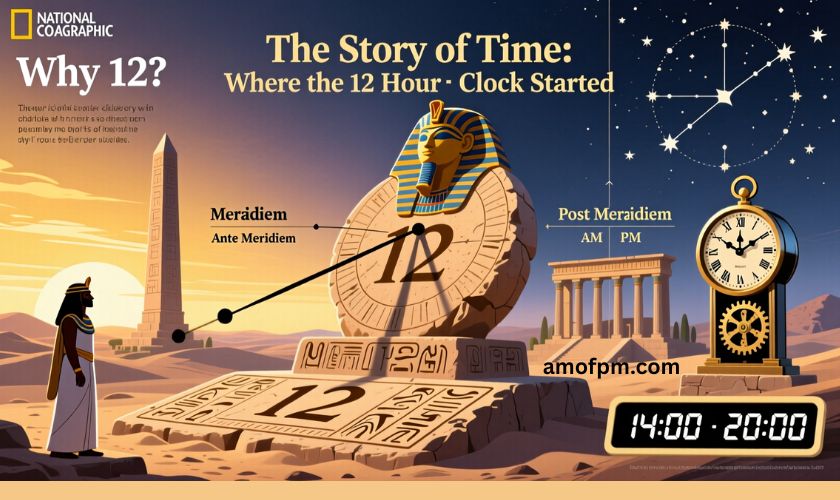
Why do we use the number 12? It is a very old system.
Ancient Egypt
The ancient Egyptians were the first to split the day into two parts. They loved the number 12. They used simple sun clocks and shadows to track the day. They divided daylight into 12 hours. Then they used the stars to divide the night into 12 hours too.
Back then, their hours were not always 60 minutes long. In the summer, the day hours were long. In the winter, the day hours were short.
Roman Names
Later, the Romans kept the 12 hour split. They gave us the Latin names Ante Meridiem and Post Meridiem. The meridiem point was fixed by the shadow of a sun post.
Modern Clocks
When people finally made clocks with moving gears a few hundred years ago, the hour became a fixed, exact length of 60 minutes. But we kept the old 12 hour system and the Latin names to keep track of morning and night.
We also have the 24 hour clock (like 14:00 or 20:00). This system is used for airplanes, doctors, and in many countries because it has no AM/PM confusion. But the 12 hour AM/PM clock remains the friendliest way to talk about time.
Simple Rules for Using AM and PM
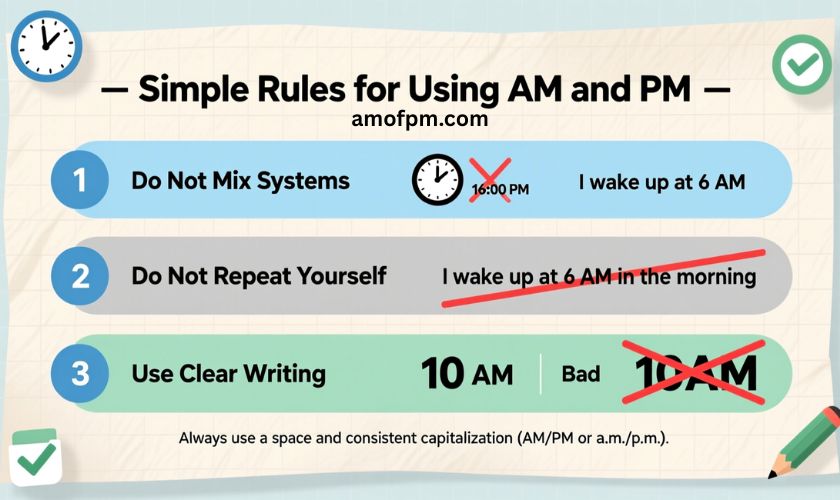
Using AM and PM correctly helps everyone follow your schedule.
1. Do Not Mix Systems
You must use AM/PM only with the 12 hour clock (numbers 1 to 12).
- Right: The train leaves at 4:00 PM.
- Wrong: The train leaves at 16:00 PM. (16:00 is already 4 PM, so adding PM is wrong.)
2. Do Not Repeat Yourself
AM already means “in the morning.” PM already means “in the afternoon/evening.” You do not need to add the extra words.
- Right: I wake up at 6 AM.
- Wrong: I wake up at 6 AM in the morning.
- Right: The movie starts at 8 PM.
- Wrong: The movie starts at 8 PM at night.
3. Use Clear Writing
Be sure you write the time so it is easy to read.
- Always leave a space between the number and the abbreviation.
- Good: 10 AM
- Bad: 10AM
- Use capital letters (AM, PM) or small letters (a.m., p.m.). Just be sure to pick one style and stick to it. Capital letters are often easier to see.
Why Getting it Right Matters
Time is a shared thing. When you use AM and PM clearly, you help others. You show you respect their time by making sure they do not show up for a meeting in the morning when you meant the evening.
It is easy to stop making the small mistakes many people make:
- Mistake: Telling someone, “Meet me at 3.”
- Fix: Say, “Meet me at 3 PM” or “Meet me at 3 AM.”
- Mistake: Using 12 AM for the end of the day.
- Fix: Use “midnight” to show you mean the start of the next day.
- Mistake: Using AM/PM on a flight schedule.
- Fix: Use the 24 hour clock (like 09:00 or 22:00) for important travel or official papers where mistakes cannot happen.
Learning these small details about AM and PM makes you better at managing your life and makes sure you are always on time.
Questions You Might Have About Time
When does the time switch from AM to PM?
The switch happens at 12:00 PM (noon). The time right before is 11:59 AM.
When does the time switch from PM to AM?
The switch happens at 12:00 AM (midnight). The time right before is 11:59 PM.
Is it okay to just say “noon”?
Yes, it is the best idea. Saying “noon” or “midnight” is clearer than using 12 PM or 12 AM because many people get those two confused.
Where does the word “meridiem” come from?
Meridiem is a Latin word that means “midday” or “noon.” It comes from the word meridies. We use it to mark the exact middle of the day.
Should I use dots, like A.M. and P.M.?
You can use dots (A.M., P.M.) or no dots (AM, PM). Both are correct. Many people today skip the dots (AM, PM) because it looks neater on a phone or computer screen.
Final Thought
You now hold the simple key to precise timekeeping. AM and PM are more than just two letters; they are the anchors of your daily schedule. They link the history of the sun clock to your modern digital calendar.
Do not let 12 AM or 12 PM cause you stress. Remember that AM is for the morning, and PM is for the afternoon. Use “noon” and “midnight” to guarantee clarity every single time. By using these terms correctly and confidently, you take full control of your schedule and communicate better with everyone around you. Time is a resource you cannot get back. Use it wisely, starting with these two powerful abbreviations.