
You see AM and PM all the time. They are on your clock, your phone, and your calendar. Do you really know what they mean? Knowing the difference is very important. If you mix them up, you could miss a flight, be late for work, or show up for a dinner at breakfast time.
Clear communication about time matters. This simple detail changes your whole day.
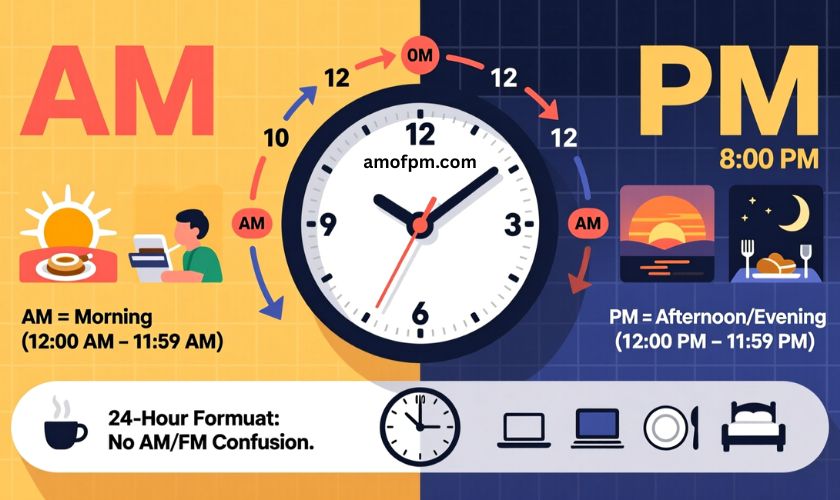
This article makes the difference between AM and PM very simple. You will learn what they stand for. You will know how to use them every time without a mistake. We will also look at the 24 hour clock, an easy way to avoid all confusion.
What Do AM and PM Really Mean?
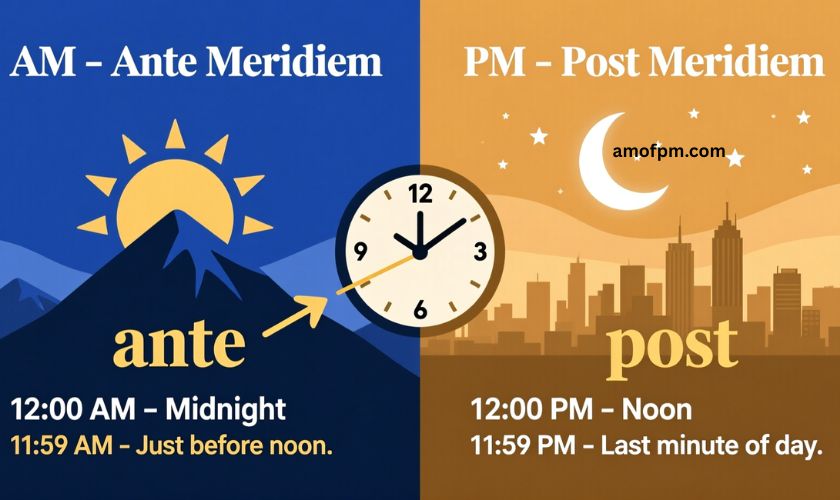
People often think AM and PM come from English words. They do not. They are short forms that come from the Latin language.
- AM means ante meridiem.
- PM means post meridiem.
Let’s look at what the Latin words mean for your day.
Ante Meridiem (AM)
The Latin word meridiem means “noon” or “midday.” The word ante means “before.”
So, AM means “before noon.”
The AM time starts after midnight. It covers the first half of your day. It runs from the moment after 12:00 AM up until 12:00 PM (noon).
Think of AM time as morning time:
- 12:00 AM (Midnight)
- 1:00 AM (Very early morning)
- 7:00 AM (Time to wake up)
- 11:59 AM (The last minute before lunch)
Post Meridiem (PM)
Again, meridiem means “noon.” The word post means “after.”
So, PM means “after noon.”
The PM time starts right at noon. It covers the second half of your day. It runs from 12:00 PM up until midnight, which is 12:00 AM.
Think of PM time as afternoon and night time:
- 12:00 PM (Noon, lunch time)
- 3:00 PM (Afternoon break)
- 6:00 PM (Dinner time)
- 11:59 PM (The last minute before a new day)
The Big Problem: 12 AM and 12 PM
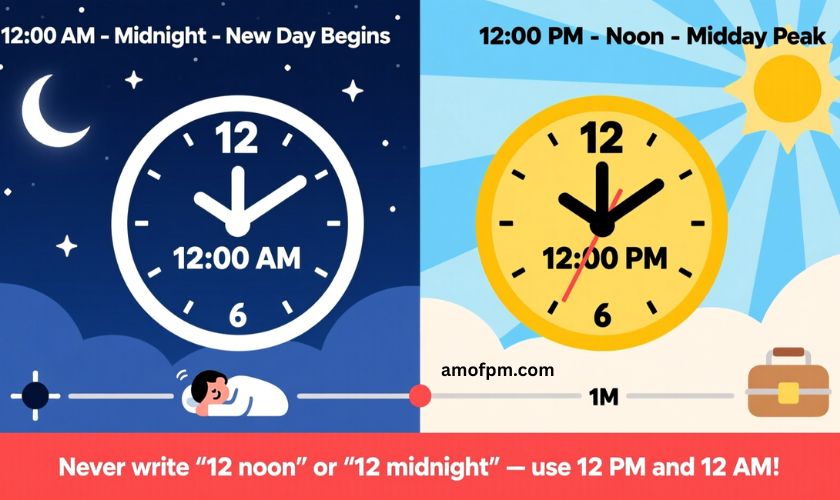
Most people get confused with the 12 o’clock time. This is where most errors happen. Because AM and PM depend on noon, the 12 o’clock hours are the key change points.
12 PM is Noon
- 12:00 PM is Noon. This is midday.
- We use PM because it starts the time after midday.
Easy Way to Remember: When you eat lunch at noon, you start the Period of Midday and the second half of the day.
12 AM is Midnight
- 12:00 AM is Midnight. This is when a brand new day begins.
- We use AM because it is the start of the hours that come before the next noon.
Easy Way to Remember: When the clock hits 12 at night, the new day has Arrived. It is the start of the AM hours.
| Time | What It Means | What is Happening | Is It Day or Night? |
| 12:00 AM | Midnight | A new calendar day begins | Night |
| 1:00 AM | Early morning | You are just starting the day | Night |
| 11:59 AM | The minute before noon | You are ending the morning | Day |
| 12:00 PM | Noon | The clock switches to afternoon | Day |
| 1:00 PM | Early afternoon | You have started the day’s second half | Day |
| 11:59 PM | The minute before midnight | You are ending the day | Night |
A simple rule: Do not write “12 noon” or “12 midnight.” Use the right abbreviations to be clear: 12 PM for noon and 12 AM for midnight.
How to Write Time for Clear Plans
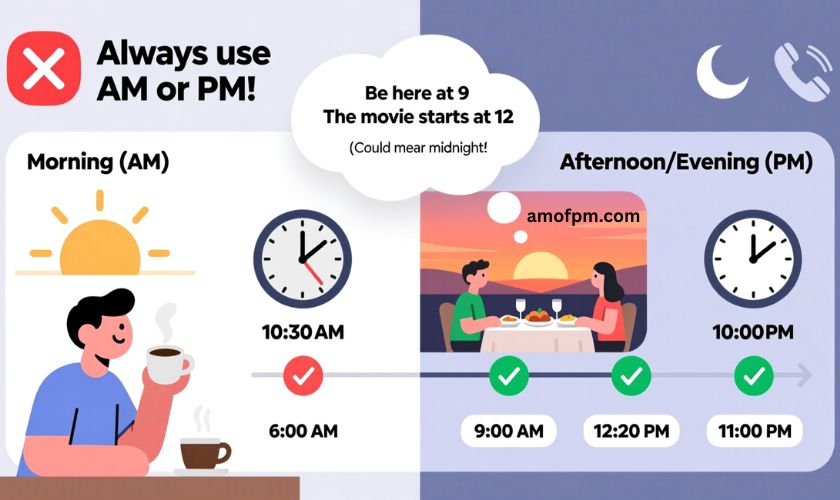
To use AM and PM right, you just need to think about what part of the day the time falls into. Does the event happen when you are usually sleeping, working, or eating dinner?
Morning Plans (AM)
If the event happens when the sun is rising or before you usually eat lunch, it is AM.
Right Ways to Use AM:
- The bus leaves at 6:00 AM. This is the morning.
- Your appointment starts at 10:30 AM. This is before noon.
- You must sign the papers by 11:00 AM. This gives you the whole morning.
When you send a text for 7:30 AM, people know you mean the morning. They will not think it is the middle of the night.
Afternoon and Evening Plans (PM)
If the event happens after you eat lunch, when the sun is going down, or at night, it is PM.
Right Ways to Use PM:
- The meeting is at 2:00 PM. This is the afternoon.
- Dinner is scheduled for 7:15 PM. This is the evening.
- The work shift ends at 10:00 PM. This is at night.
When you make a plan for 4:00 PM, your friend knows you mean after the usual workday. They will not show up before sunrise.
Three Mistakes to Stop Making
Good communication is always important. Never guess what someone means.
| The Mistake | What You Mean | What Someone Else Might Think | Why You Must Fix It |
| “Be here at 9” | 9:00 AM for coffee | 9:00 PM for a party | You did not say AM or PM. Always use it. |
| “The movie starts at 12” | 12:00 PM (Noon) | 12:00 AM (Midnight) | The 12 is too confusing. You must use PM. |
| “My event is at 11 PM” | 11:00 PM | This is correct, but check your phone for typos | Be careful writing PM late at night. Did you really mean AM? |
Be clear. Always write 9:00 AM, 12:00 PM, or 11:00 PM.
The 24 Hour Clock: The Easiest Way
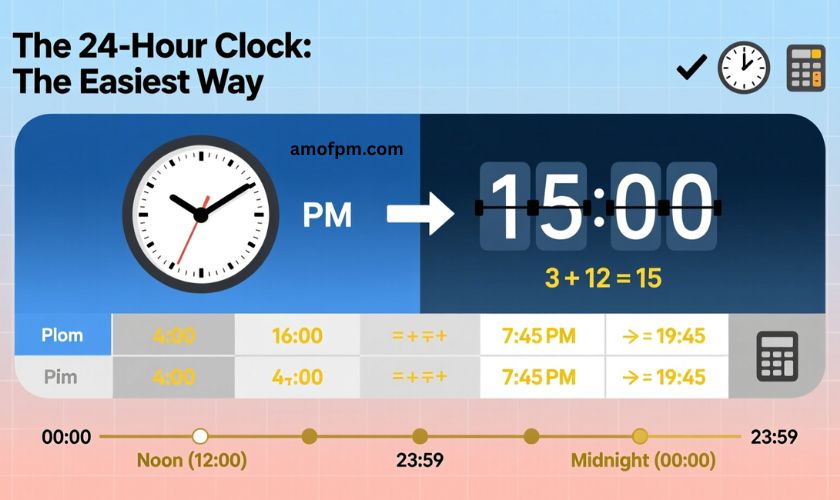
The 12 hour clock with AM and PM can still be tricky. The easiest way to never confuse time is to use the 24 hour clock. This is also called military time.
The 24 hour clock simply counts from 00:00 at midnight all the way to 23:59 before midnight. It avoids the need for AM or PM by using numbers larger than 12 for the afternoon and evening.
- 12:00 PM (Noon) becomes 12:00
- 1:00 PM becomes 13:00
- 7:00 PM becomes 19:00
- 11:00 PM becomes 23:00
How to Change PM to 24 Hour Time
This is a simple math trick. For any PM time, except 12:00 PM noon, you just add 12 to the hour.
| 12 Hour Time | The Math | 24 Hour Time |
| 4:00 PM | $4 + 12$ | 16:00 |
| 8:30 PM | $8 + 12$ | 20:30 |
| 10:00 PM | $10 + 12$ | 22:00 |
Example: If your doctor’s appointment is at 3:00 PM, you can write it as 15:00. Everyone will know it is the afternoon.
How to Change 24 Hour Time Back to PM
For any hour 13 or higher, you subtract 12 from the hour.
| 24 Hour Time | The Math | 12 Hour Time |
| 15:00 | $15 – 12$ | 3:00 PM |
| 19:45 | $19 – 12$ | 7:45 PM |
| 22:30 | $22 – 12$ | 10:30 PM |
For AM times, you just use the same number but add a zero in front if needed. 8:00 AM is 08:00.
| 12 Hour Time | 24 Hour Time Example |
| 12:00 AM (Midnight) | 00:00 |
| 5:00 AM | 05:00 |
| 11:30 AM | 11:30 |
| 12:00 PM (Noon) | 12:00 |
| 6:00 PM | 18:00 |
| 11:59 PM | 23:59 |
The 24 hour clock is very clear. Big companies like airlines use it because it avoids all confusion. You should use it when you need to be perfectly clear.
Read: Stop the Clock Confusion: A Simple Guide to Mastering AM and PM
Simple Rules to Always Get the Time Right
You now have the simple tools to be a master of telling time. Remember the basic Latin meanings and the switch points at 12:00. Being clear about time is a skill. It helps you and everyone you talk to.
Your Final Time Rules:
- Remember the Latin: AM means before noon. PM means after noon.
- Know the 12s: 12 AM is midnight. 12 PM is noon.
- Always Write It Out: Never write “Meet at 5.” Write 5:00 AM or 5:00 PM.
- Use 24 Hour Time for Safety: When you must be 100% clear, use 24 hour time. 14:00 always means the afternoon.
Use this simple knowledge to schedule your days better. Clear time communication means less stress and fewer mistakes.
Questions People Ask (FAQs)
Which is 12 AM? Morning or night?
12:00 AM is midnight. It is the very start of a new day. So, it is night, but it begins the new morning’s hours.
Should I use capital letters for AM and PM?
Yes, you should use capital letters: AM and PM. You can use periods, like A.M. and P.M., but using them without the dots is more common now. Just choose one way and stick to it.
What happens right at the change?
The change happens right at the 12:00 mark. The last minute of the morning is 11:59 AM. The very next minute is 12:00 PM (noon). The same is true at midnight. The last minute of the day is 11:59 PM. The next minute is 12:00 AM.
Can I use AM or PM with the 24 hour clock?
No. The 24 hour clock is made to replace AM and PM. If you write the time as 17:00, you already know it is the afternoon. You do not need to add PM.