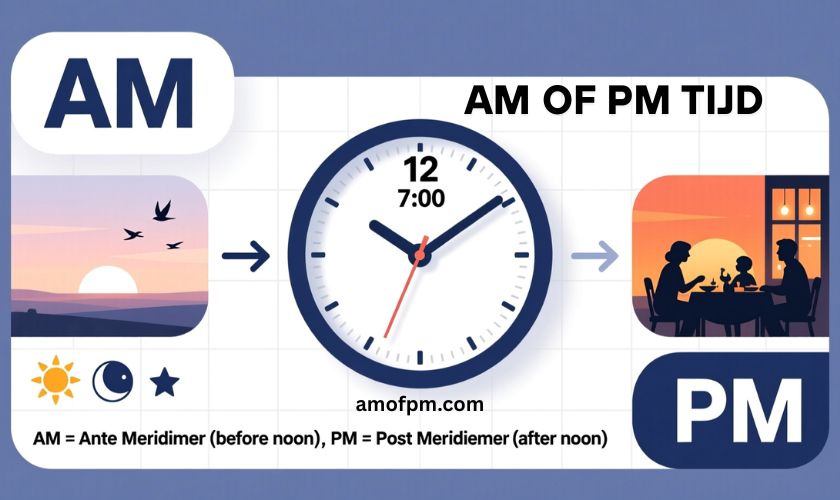


When you read “12 PM Nederlandse Tijd“ it tells you a time in the Netherlands. You need to know that time where you live. This simple time is a little hard to figure out. Why? The Netherlands changes its clock two times each year.
To know 12 PM in the Netherlands, you must know about two time names: CET and CEST. You need clear answers when you work with people far away. This paper gives you those answers. We make the confusing parts clear. We show you how to change 12 PM Netherlands time to your local time. You can do this right every time.
The Main Time CET Central European Time
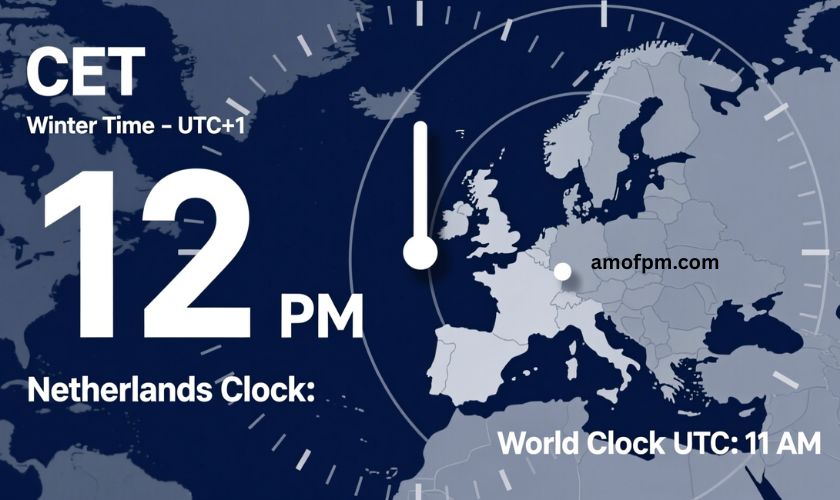
The base time for the Netherlands is Central European Time or CET. This is the time they use in the winter. CET is one hour ahead of a world clock called UTC. We write this as UTC+1.
Think of UTC as the world’s zero time. It is the start point for all other times. It is like GMT which you may know. The world uses UTC to keep all clocks together. The Netherlands runs one hour faster than this zero time in the cold months.
So, when it is noon, 12 PM in the Netherlands in winter, you can find the world time quickly.
- Netherlands Clock: 12 PM CET (UTC+1)
- World Clock UTC: 11 AM
You just take away one hour to get back to the world’s start time. This one-hour gap stays the same from around October to March. Knowing this base time is the first step. You must know if the country is using its winter time or its summer time.
The Summer Change CEST Central European Summer Time
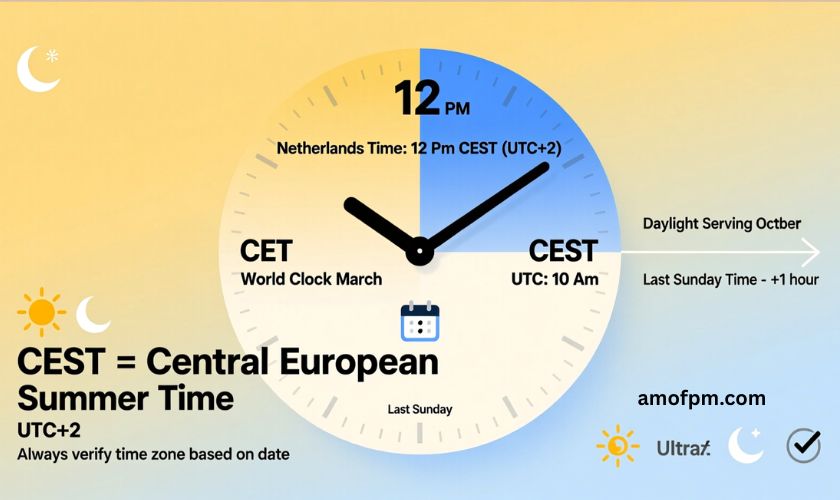
Here is the second part that makes things a bit hard. The Netherlands uses Daylight Saving Time or DST. This means they move their clock forward by one hour for the sunny months. When they do this, the time name changes. It goes from CET to Central European Summer Time or CEST.
CEST is two hours ahead of the world clock UTC. You write this as UTC+2. This clock change usually happens on the last Sunday in March. It ends on the last Sunday in October.
In these summer months, 12 PM Netherlands time means a very different time for your work.
- Netherlands Clock: 12 PM CEST (UTC+2)
- World Clock UTC: 10 AM
The change is important. A 12 PM meeting in the Netherlands is 11 AM UTC in winter. But it is 10 AM UTC in summer. You must check the date of your meeting. You must use the right name CET or CEST. Do not guess the time.
Why Do We Need Different Time Zones
You might ask why all this is needed. Why not have just one time for every place? The main reason is the sun.
People need the sun to be high when they are working. Noon should be near the time the sun is highest. If the world used the same time, people on the other side of the earth would start work at 3 AM. They would eat lunch at midnight. This is not good for people or for life.
Time zones help people locally. The Netherlands picked UTC+1 as its normal time. This one-hour shift makes the sun highest around 1 PM in their towns. This helps daylight hours fit with normal life, like waking up and eating. Time zones are a way to make the world clock work with local daily life.
How to Change 12 PM Netherlands Time to Your Time
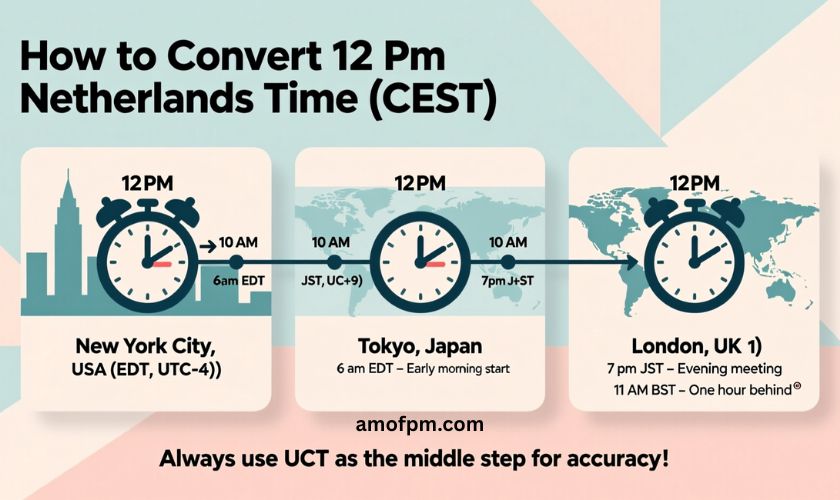
Let us look at how to change 12 PM Nederlandse Tijd to some other cities. You need two facts for every change.
- Is the Netherlands using CET or CEST? This is the first important question.
- What is your local time’s gap from UTC? For example, New York is UTC-5 in winter.
We will use the summer time for this math. So the Netherlands is on CEST, UTC+2.
Example 1 New York City, USA
New York uses EDT in the summer. EDT is UTC-4.
- Start Time: 12 PM CEST Netherlands
- Change to UTC: 12 PM minus 2 hours is 10 AM UTC
- Change to New York: 10 AM UTC minus 4 hours is 6 AM EDT
A 12 PM meeting in Amsterdam means you must wake up very early in New York. The meeting starts for you at 6 AM.
Example 2 Tokyo, Japan
Tokyo uses JST. JST is always UTC+9. Japan does not change its clock for summer.
- Start Time: 12 PM CEST Netherlands
- Change to UTC: 12 PM minus 2 hours is 10 AM UTC
- Change to Tokyo: 10 AM UTC plus 9 hours is 7 PM JST
A 12 PM meeting in Amsterdam means you will work late in Tokyo. The meeting starts for you at 7 PM.
Example 3 London, UK
London uses BST in the summer. BST is UTC+1.
- Start Time: 12 PM CEST Netherlands
- Change to UTC: 12 PM minus 2 hours is 10 AM UTC
- Change to London: 10 AM UTC plus 1 hour is 11 AM BST
The time gap between the Netherlands and the UK is only one hour in the summer. The meeting starts for you at 11 AM in London.
You can use this three-step plan for any city. Always use the UTC start time. This is the surest way to change the time.
Why Time Change Dates Matter
You must look closely at the days the Netherlands moves its clock. Europe uses a simple rule. The clock moves on the last Sunday of March. It moves back on the last Sunday of October.
If your work is due near these dates, you need to know the exact day and hour of the clock change. A big meeting set for the day the clock changes can cause a lot of worry.
Think about a meeting on the last Sunday in March. At 2 AM, the clock jumps forward to 3 AM in the Netherlands. If your meeting is at 12 PM that day, it is 11 AM UTC. The time gap stays the same on Sunday. But the clock time moves. This is why you must use good tools or the UTC number.
How to Talk to People Across the World

Knowing how to handle 12 PM Nederlandse Tijd is a good sign you plan well. If you are the one setting the time, you should always write the time in many zones. The best way is to use UTC.
Do not write only “Meeting at 12 PM Netherlands Time.” Write this instead:
- “Meeting at 10 AM UTC (which is 12 PM CEST Netherlands Time)”
This makes it clear for everyone. Your friends in Tokyo know 10 AM UTC is 7 PM for them. Your friends in New York know 10 AM UTC is 6 AM for them. You make it easy for all your team.
You save time and stop mix-ups when you use the UTC standard. Make it a simple rule for all your emails and messages that go to other countries.
What if the Netherlands Stops DST
People in Europe, like the Netherlands, still talk about Daylight Saving Time. Many people do not like the clock change. The European Union has talked about stopping the time switch forever.
If the Netherlands stopped and stayed on CET (UTC+1), the change would be much easier all year. If they stopped and stayed on CEST (UTC+2), the change would also be simple. It would just be two hours ahead of UTC all the time.
This change would be great for your work. You would not have to check the calendar for CET or CEST. But until they change the rule, you must keep checking for the right time zone gap.
Read: AM of PM: The Simple Guide to Telling Time and Scheduling Success
Simple Tools to Help You with Dutch Time
You should not do the math in your head for every meeting. Use simple online tools.
- World Clock Sites: These websites are made to show you the current time in Amsterdam. They compare it to your location. They know about Daylight Saving Time.
- Calendar Tools: Most modern calendars, like Google Calendar or Outlook, will ask for the time zone. They change the event time for the people you invite. Always check that the tool used CET or CEST for Amsterdam’s time.
- Your Phone: Your cell phone has a world clock. Add Amsterdam to the list. You can see the time now and figure out the difference fast.
You do not need to learn all the time zones. You just need to know how to use these tools well.
Key Things to Remember for Your Schedule
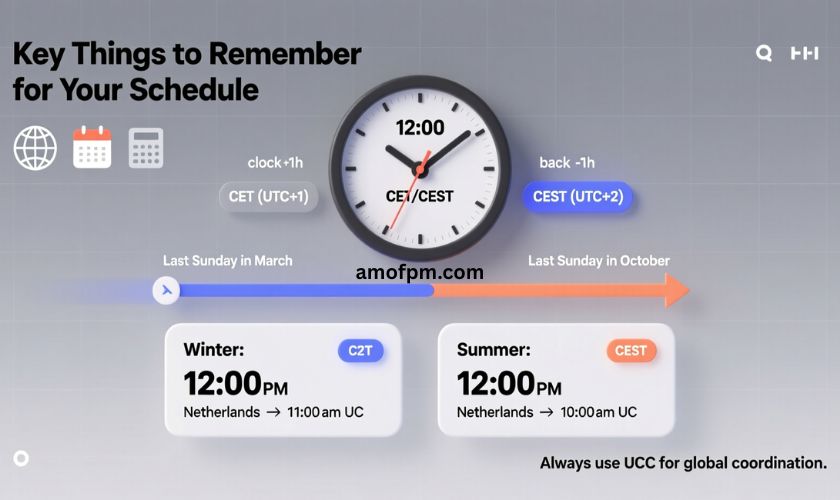
Keep these facts about 12 PM Netherlands time in your mind. This will help your plans be correct.
- CET (UTC+1) is the time for winter. 12 PM is 11 AM UTC.
- CEST (UTC+2) is the time for summer. 12 PM is 10 AM UTC.
- The clock moves on the last Sunday in March. It moves back on the last Sunday in October.
- Always use the UTC world time for global work.
- Use online tools so you do not make math mistakes. This is most important near the clock change days.
You are in charge of your schedule. Knowing the rule about CET and CEST helps you work around the world without making mistakes. Be careful with every time note you see. The time is now 12 PM in the Netherlands. You know exactly what that means for your day.
Simple Questions About 12 PM Netherlands Time (FAQs)
What is 12 PM Nederlandse Tijd in world time (UTC)?
It changes with the season. In winter (October to March), 12 PM is CET (UTC+1). This means 11 AM UTC. In summer (March to October), 12 PM is CEST (UTC+2). This means 10 AM UTC. You must look at the calendar date.
Is the Netherlands always one hour faster than London?
Yes. The Netherlands and London both use Daylight Saving Time. The Netherlands goes to UTC+2 in summer. London goes to UTC+1 in summer. The difference stays at one hour all year. For example, 12 PM in the Netherlands is 11 AM in London in both seasons.
Is Amsterdam time the same as Paris time?
Yes. Amsterdam and Paris use the same time. Both use CET (UTC+1) in winter and CEST (UTC+2) in summer. You can think of them as the same time zone when you plan.
How can I change 12 PM Netherlands time to my time without mistakes?
Use three steps. First, find out if the Netherlands is on CET (UTC+1) or CEST (UTC+2). Second, change that time to the UTC time. Third, change from UTC to your local time’s UTC number. If the Netherlands is on CEST, 12 PM is 10 AM UTC. If you are UTC-5, you take away five hours from 10 AM UTC. Your meeting is at 5 AM.
Will the Netherlands stop changing its clocks for Daylight Saving Time?
The European Union has talked about stopping the clock change. If this happens, the Netherlands would pick one time, either CET or CEST, all year. But no final rule has been made yet. You must still check for the time switch two times a year.
Final Thoughts
You now know the simple rule for 12 PM Netherlands Time.
Do not guess the time. Always check if the Netherlands is on CET (winter, UTC+1) or CEST (summer, UTC+2).
Use UTC as your global starting point for all conversions. This makes your international scheduling easy and error-free. You are ready to set global meeting times correctly every time.