
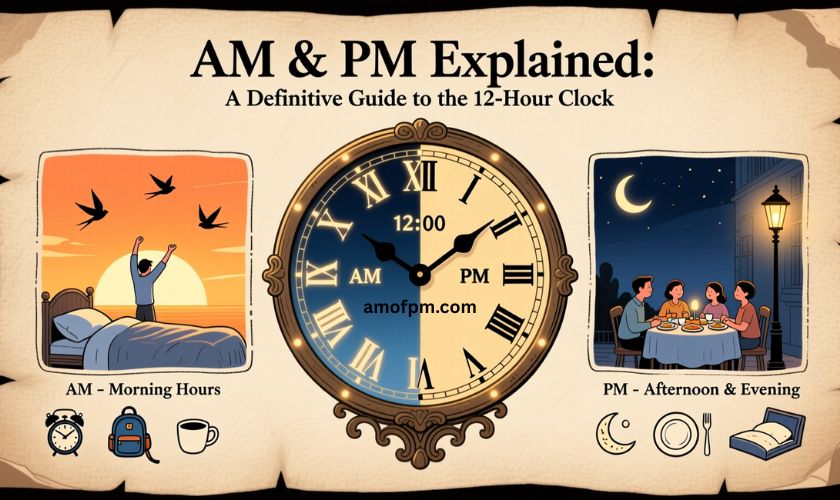
You see AM en PM all the time. They are the small letters that help us tell time on a 12 hour clock. They decide when you start your day, when you go to work, and when you go to sleep.
Many people get confused about what AM en PM mean, especially when it comes to noon and midnight. If you have ever been late or missed a plan because you mixed up these times, this guide is for you. We will make it very clear. Understanding AM en PM gives you control over your whole day.
Let’s look at what these letters really mean.
What Does AM Mean?
The letters AM stand for a Latin phrase: Ante Meridiem.
You don’t need to know Latin. You only need to know what it means in simple English: before noon.
-
Ante means “before.”
-
Meridiem means “midday” or “noon.”
So, AM covers the time from the middle of the night until the middle of the day.
The AM time starts at 12:00 AM and ends at 11:59 AM.
12:00 AM is midnight. This is the exact moment a new day begins. Every hour after midnight, like 1:00 AM, 6:00 AM (when you wake up), and 10:00 AM (when you are working), is AM.
What Does PM Mean?
The letters PM stand for another Latin phrase: Post Meridiem.
This phrase means the opposite of AM: after noon.
-
Post means “after.”
-
Meridiem means “midday” or “noon.”
PM covers the second half of the day, from the middle of the day until the middle of the night.
The PM time starts at 12:00 PM and ends at 11:59 PM.
12:00 PM is noon. This is the middle of the day, when the sun is highest. Every hour after noon, like 1:00 PM (lunchtime), 6:00 PM (dinner), and 10:00 PM (before bed), is PM.
The Trickiest Part: Noon and Midnight
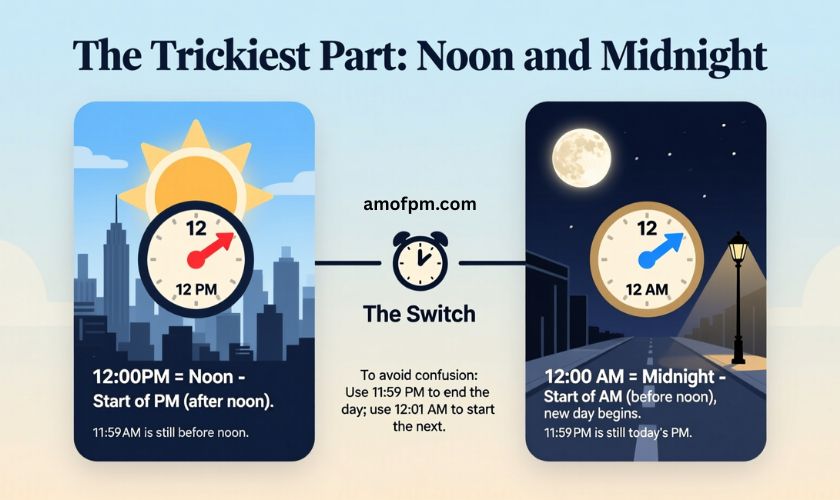
The biggest mistake people make is mixing up 12 AM and 12 PM. Getting these wrong can change your schedule by 12 hours.
Noon: It is 12 PM
Noon is the time when the clock switches from AM en PM. Since PM means “after noon,” the moment noon happens, it is the start of the PM time.
-
11:59 AM is still “before noon.”
-
12:00 PM is noon, and it starts the “after noon” time.
If you plan a quick lunch, you write 12:00 PM.
Midnight: It is 12 AM
Midnight is the time when the clock switches from PM back to AM, and a new day begins. Since AM means “before noon,” the moment midnight happens, it is the start of the AM time for the new day.
-
11:59 PM is still part of today’s “after noon” time.
-
12:00 AM is midnight, and it starts tomorrow’s “before noon” time.
Key Tip: If you have a deadline or a travel time close to midnight, be very clear. To avoid confusion, many people say 11:59 PM for the end of a day, or 12:01 AM for the start of a new day. But remember the rule: 12 AM is midnight.
Why We Use the 12 Hour Clock
The idea of splitting the day into two 12 hour parts is very old. Ancient people, like the Egyptians and Romans, used similar systems. Today, the 12 hour clock with AM en PM is normal in many countries, including the United States, Canada, and Australia.
It is Simple and Easy
The main reason we keep using the 12 hour clock is that it is easy to read. It matches the face of an analog clock perfectly. You look at the clock and see the number. Then you use AM en PM to know if it is morning or night. This is often easier for daily life than using numbers up to 24.
The 24 Hour Clock: The Clear Alternative
You may also know the 24 hour clock, sometimes called military time. This system uses numbers 00 to 23 for the whole day.
| 12 Hour Time | 24 Hour Time | Note |
| 1:00 AM | 01:00 | Early Morning |
| 6:00 AM | 06:00 | Waking Up |
| 10:00 AM | 10:00 | Late Morning |
| 12:00 PM | 12:00 | Noon (Midday) |
| 1:00 PM | 13:00 | Afternoon (12 + 1 = 13) |
| 6:00 PM | 18:00 | Evening (12 + 6 = 18) |
| 10:00 PM | 22:00 | Late Evening |
| 12:00 AM | 00:00 | Midnight (New Day) |
The 24 hour clock is used around the world, especially for things like air travel, trains, and science, because it removes all chance of mixing up AM en PM. To go from PM time (afternoon) to 24 hour time, you just add 12 to the hour.
How to Use AM en PM Right Now
You can easily avoid time mix ups with a few simple checks.
1. Think About the Sun
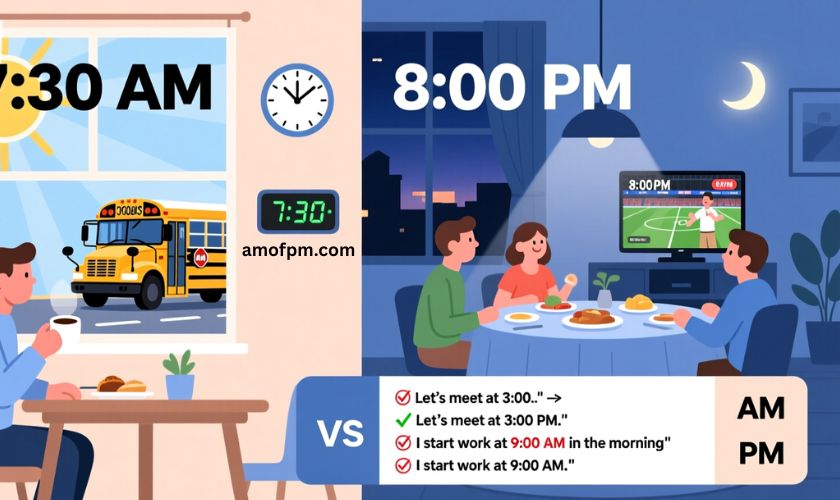
If the sun is up or you are awake for breakfast, it is AM. If it is dark, or you are having dinner, it is PM.
-
The school bus comes at 7:30 AM.
-
We will watch the game at 8:00 PM.
2. Always Write AM en PM
Never just write a number for time. If you say “Meet me at 3:00,” your friend will not know if you mean the morning or the afternoon. Always include the letters.
-
Bad: “Let’s meet at 3:00.”
-
Good: “Let’s meet at 3:00 PM.”
3. Do Not Use Extra Words
The letters AM and PM already tell you morning or afternoon. Do not add those words. It sounds repetitive and can be confusing.
-
Bad: “I start work at 9:00 AM in the morning.”
-
Good: “I start work at 9:00 AM.”
-
Good: “I start work at 9 in the morning.”
4. Write Them Clearly
The best way to write the abbreviations for daily use is simply AM en PM. Use capital letters and no periods. This is how you see them most often on phones and computers, and it is the clearest way.
Read: 12 PM Power: Master Noon for Better Focus and a Perfect Schedule
Why This Matters for Your Life
Mastering AM en PM is important for keeping your life running smoothly. A small mistake can have a big effect.
-
For Meetings: If you have a video call scheduled for 7:00, is that when you are starting your day or ending it? Check the AM en PM to make sure you do not log in 12 hours late or 12 hours early.
-
For Travel: Imagine you book a train that leaves at 1:00. If you think it is 1:00 PM, you will arrive in the afternoon. If it is actually 1:00 AM, the train left right after midnight and you missed it. Always check the ticket time closely.
-
For Alarms: We all do this. You set your alarm clock for 6:00, but did you choose PM instead of AM? You will sleep through the entire morning. Always double check that little AM on your screen before you go to bed.
The 12 hour clock is a very simple system. If you remember that AM is before noon and PM is after noon, you will always get it right. Use these two abbreviations clearly and correctly, and you will stay organized and on time. You can now use your clock with confidence.
FAQs: Quick Answers to Your Clock Questions
1. When does AM really start and end?
AM starts at 12:00 AM (midnight) and ends right before noon, at 11:59 AM.
2. Is 12 PM noon or midnight?
12 PM is noon. PM means “after noon,” so noon is when that period begins. 12 AM is midnight.
3. Why do we still use AM en PM instead of the 24 hour clock?
Many people prefer the 12 hour clock because it is traditional and easy to read on an analog clock face. It is simpler for daily talk.
4. If a time is 4 o’clock, should I write 4:00 AM or just 4 AM?
You can write 4:00 AM or 4 AM. Both are fine. Adding the two zeros (00) is good for formal schedules, but just 4 AM is clear enough for most daily messages.
5. How can I easily change 24 hour time to 12 hour time?
If the hour is 13 or more, it is PM. Just subtract 12. For example, 15:00 is $15 – 12 = 3$, so it is 3:00 PM. If the hour is 11 or less, it is AM.
Final Thoughts
The 12-hour clock, with its simple AM en PM labels, remains a core part of how we organize our lives. While the system dates back centuries, its function is timeless: to clearly separate night from day.
Do not let these two small abbreviations cause you stress or scheduling errors. You have broken down the meanings of Ante Meridiem (AM) and Post Meridiem (PM) into clear, workable knowledge.
Use this knowledge to take control. When you write a time, always include the AM or PM. When you set a reminder, always double-check the label. By confidently applying the simple rule—12 AM is midnight, 12 PM is noon—you ensure that your schedule runs on your terms. Mastering these two letters is a small step that brings massive clarity to your entire day.